Emergency Roof Repair in French Quarter, New Orleans
Creole townhouses built after the fires of 1788 and 1794, most of them slate or clay tile behind a parapet. Every exterior change here answers to the Vieux Carré Commission, and we plan the job around that from day one.
- Vieux Carré Commission jurisdiction
- Slate and clay tile, repaired not replaced
- Courtyard and gallery access planned
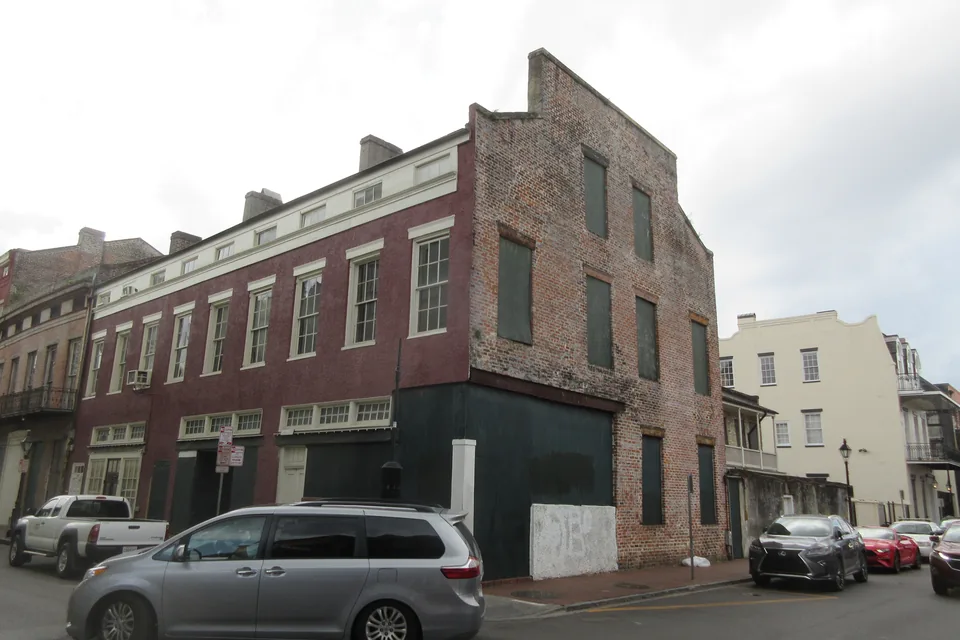
French Quarter building stock, and what it means for a roof
The Quarter is the oldest building stock in the city and almost none of it is original to the French colonial period — the great fires of 1788 and 1794 took most of that. What stands today is largely Spanish-influenced Creole townhouses raised after those fires: two to four stories of brick or stucco, built to the front property line, with courtyards behind and cast-iron galleries over the banquette.
Roofs here mix slate, clay tile and low-slope sections hidden behind parapets and party walls, often all on one building. That matters because the Vieux Carré Commission — which governs the Quarter under its own enabling legislation, separately from the rest of the city’s historic districts — treats what is visible from the street as a preservation question, not a contractor’s choice. Standing seam metal is generally not accepted as a substitute for an existing slate or tile roof here.
Why French Quarter roofs fail the way they do
Three things we see repeatedly on this stock — not a generic list, and not the same three as the next neighborhood over.
Slipped and broken slate
Individual slates work loose long before the roof as a whole is finished. The correct answer on a Quarter roof is usually a matched replacement slate, not a tear-off.
Parapet and party-wall flashing
Buildings share walls on both sides. Water entering at a neighboring parapet shows up inside your top floor, which changes whose repair it actually is.
Hidden low-slope sections
Behind the visible pitched front there is often a flat rear over the service wing. It is the part nobody sees and the part that usually leaks first.
Do this while you wait for us
Five things that limit the damage. None of them involve going onto the roof — in a storm, in the dark, on a wet New Orleans roof, that is how people get hurt.
- Move what matters out of the way. Electronics, documents, anything soft. Water spreads along a ceiling far wider than the visible drip.
- Put a container under it and a towel in the container. The towel stops the splash-back that spreads the damage sideways.
- If the ceiling is bulging, pierce it deliberately. A small hole at the low point drains it into your bucket. A bulging ceiling that lets go on its own takes the whole sheet with it.
- Kill power to the affected area at the board if water is anywhere near a light fitting, a fan or a socket.
- Photograph everything before you clean up. Time-stamped photos of the water while it is still coming in are worth a great deal in a Louisiana claim.
When we cover
Hurricane season runs June through November and does not respect a schedule. Overnight, weekends and holidays are covered. During a named storm we do not put crews on roofs while it is still blowing — nobody credible does — but we take the call, log you, and we are moving as soon as it is survivable.
An honest word about tarping
A tarp is a stop-gap, not a repair. Fitted properly it buys weeks and stops the inside getting worse; it does not fix anything and it should never be sold to you as though it does. We tarp to make a building safe and dry, then come back in daylight and diagnose the roof properly.
The season, and what it asks of a roof
Gulf Coast roof failure is a wind story, not a hail story. The damage that matters is uplift — seals broken, edges lifted, water driven under what is left.
The window for finding lifted edges, tired flashing and loose ridge caps while there is still time to fix them calmly and at a normal price.
Peak season. Demand spikes, good crews book out, and the roofs that get attention first are the ones already on somebody’s list.
Nobody credible puts a crew on a roof while it is still blowing. We take the call, log the address, and move the moment conditions allow.
Make safe, dry in, document for the claim, then diagnose properly in daylight. In that order, and not all in one visit.
Four stages, no surprises
Call
A person answers and logs the address, the situation and whether anyone is at risk. Any hour, through the season.
Make safe
Power risk, ceiling risk and occupancy dealt with first. The building is made safe before the roof is touched.
Dry in
The opening closed properly so nothing more gets in tonight — honestly labeled as a stop-gap, not a repair.
Diagnose in daylight
We come back and find out what actually failed, then quote the real repair in writing.
Working around Jackson Square, St. Louis Cathedral, The Cabildo and the surrounding streets. If your address is in French Quarter, it is in the service area — there is no travel surcharge anywhere inside Orleans Parish.
Emergency Roof Repair near French Quarter
Everything else we do in French Quarter
Emergency Roof Repair in French Quarter — straight answers
Do you actually answer at night during storm season?
Yes. Hurricane season runs June through November and does not keep office hours. A person takes the call, logs the address and the situation, and tells you honestly when a crew can be with you.
Will you come out during the storm itself?
Not while it is still blowing. Nobody credible puts a crew on a roof in those conditions, and any contractor who promises otherwise is either lying or dangerous. We take the call, log you, and move as soon as it is survivable.
Is a tarp a repair?
No, and we will not sell it to you as one. A properly fitted tarp stops the inside getting worse and buys you weeks. The actual repair gets diagnosed in daylight and quoted separately, in writing.
Does the Vieux Carré Commission have to approve my French Quarter roof?
If the work is visible — the slate or tile field, the ridge, coping, or anything facing the street — then yes, it goes through the Vieux Carré Commission, a separate body from the HDLC with its own authority under the Louisiana Constitution. A re-roofing permit from the Department of Safety and Permits is required as well, and historic-district properties take additional review time before that permit is issued. We build that time into the schedule rather than discovering it mid-job.
Emergency Roof Repair in French Quarter?
Call and we will get someone on the roof, then put what we find in writing.